

Opportunism and the United Front

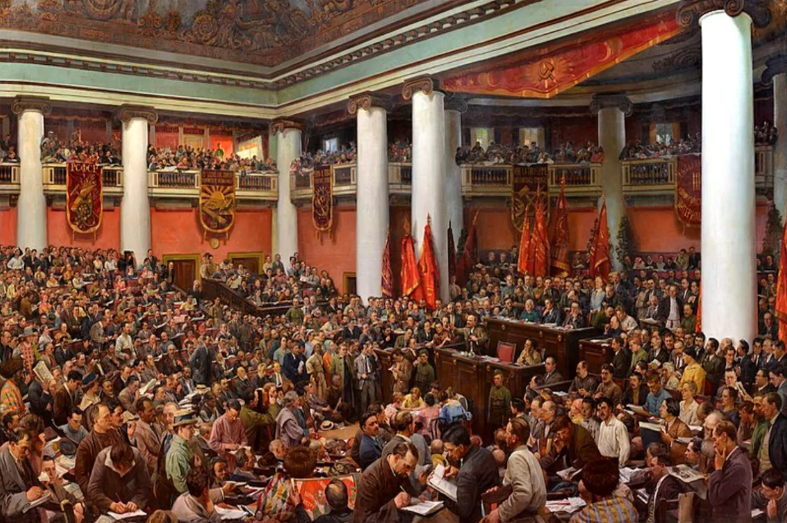
Translated by our comrades of League of Internationalist Communists
Download PDF here
In this text, we continue the reflection we began in our previous essay on mass parties and in an earlier contribution such as The Past of Our Being. As we saw, the tactic of the mass party led the nascent Third International down the path of political opportunism. The limitations of the Second International, which had previously been fought against, re-entered through the window in the perspective that it was necessary to obtain a majority of support within the working class in order for the revolutionary process to erupt. The tactic of winning over the masses and merging with the left wings of social democracy was accompanied, from the Third Congress of the Communist International onwards, by that of the united front with social democracy. Social democracy was characterised as the “right wing of the workers’ movement”. Added to all this was the tactic of the Workers’ Government, set forth in the Fourth Congress of the International, as a preliminary phase to the dictatorship of the proletariat. That is, the tactic of coalition governments between communists and social democrats within the framework of bourgeois states.
Such tactics are markedly opportunistic, as we will analyse in detail in this text. In this way, they contributed to the counter-revolutionary transformation of the Communist International from the late 1920s onwards. However, it is important to make a distinction here between opportunism and counter-revolution. Opportunism is a characterisation of organisations and militants who are still part of our class camp.
Obviously, opportunism favours the affirmation of counter-revolutionary positions and hinders a return to uncompromising communist and revolutionary positions. But one thing is not the same as the other; opportunism is not counter-revolution. One is opportunistic in relation to the positions and class camp to which one belongs. One example seems very clear to us in this regard: Trotsky. His political opportunism did not prevent him from waging a fight against the consolidation of the counter-revolution that cloaked itself in red, whether in the struggle within Russia with the Left Opposition or internationally to combat the Comintern’s policies of alliance with the progressive bourgeoisie. These were criminal policies that led to proletarian defeats in England and China as early as the 1920s. However, this opportunism greatly limited the type of political struggle Trotsky waged against the counter-revolutionary course of the official “communist” parties and of Russia as the central vector of that counter-revolution. Part of these limitations had to do with how Trotsky took up the tactics of the united front and the workers’ government alongside the transitional demands of those early congresses of the Communist International, passing off social democracy and later national communism as opportunist sectors of the workers’ movement. Failing to see these currents as directly bourgeois and counterrevolutionary was a fatal mistake for Trotsky and later for Trotskyism. In this way, Trotskyism crossed class lines during World War II, becoming a force of capital during World War II through its support for national resistance movements and one of the imperialist camps during World War II.
The socialisation of capital integrated the mass organisations of the labour movement in the first half of the 20th century. First, it did so with social democracy in 1914 as a symbolic date, and then with the ‘communist’ parties from the late 1920s onwards. The counter-revolution prevailed after the defeat of the revolutionary labour movement. Integration, as we saw in the previous text, was no accident. The metamorphosis of capital, its tendency to colonise all aspects of social life, caused the organisations and tactics that the labour movement had developed during the period of the Second International to become integrated into the reproduction of capital. Reformism was transformed into conformism with capital. Class organisations became the left wing of capital.
From the above, it follows that those large mass “communist” parties, created in the period from the 1930s to the 1950s, are not working-class organisations. In fact, this is obvious to any internationalist revolutionary of the period. It was a truism that was woven into the policies of the Comintern in the service of the Russian state and its accumulation of capital, based on the organisation of proletarian defeats everywhere and the torture and murder of revolutionaries and internationalists. These large mass parties were one of the most powerful vectors that served to maintain the predominance of the counter-revolution during those decades that turned into midnight at the turn of the century for the revolutionary proletariat. They are brutally counter-revolutionary and bourgeois organisations whose strength has been decisively eroded today.
When the Trotskyists, after World War II, called for a united front with social democracy and the official “communists”, they were not only living in a dream world, failing to recognise the bourgeois nature of these organisations, but they also functionally integrated themselves into them as the left wing of these bourgeois and counter-revolutionary organisations. They became the (useless) advisers who told the counter-revolutionary leaders of the workers’ movement what to do: Mandel to Tito, Pablo to Ben Bella, Moreno to Perón, and Maitan to Mao, to give just a few examples.[1]
The opportunist tactics of the early 1920s sounded very different thirty years later. And it could not be otherwise. Enormous counter-revolutionary cataclysms had swept through those years: fascism and Nazism, Stalinism, World War II, democratic socialisation. In short, the defeat of the workers’ movement had been total. The tasks of the moment were to take stock of the defeats of the past in order to prepare for future proletarian assaults once the counter-revolution began to erode.
But let us go back to the origins of all this. How did the opportunist policy of the Communist International begin?
The Third Congress of the International
Prior to the explicit implementation of the so-called proletarian united front, the Theses on Tactics drafted at the Third Congress of the Communist International between 22 June and 12 July 1921 were adopted. The premises of the Theses on Tactics were based on something that all comrades at the time recognised: the international revolutionary wave that broke out in 1917 was in retreat in 1921. Capitalism had not yet been overthrown, contrary to the most optimistic beliefs expressed at the first congresses of the International. From there, differences arose between the centre and leadership of the Communist International and the communist left over what tactics to follow. What these Theses, drafted by the Russian delegation to the Congress with Lenin playing a leading role in their drafting and content, propose is the need to go to the masses and win over the majority of the working class before the revolutionary outbreak. All this to allow the revolution to take place. In this sense, at the beginning of the Theses, the most opportunistic parties of the International, such as the Czech, German and French parties, are given as positive examples to follow. The decisive factor would be:
“The most important problem of the Communist International at present is to win over the majority of the working class and to involve the decisive sections of this class in the struggle.”
Obviously, the position of the Italian communist left was never to defend the idea that the communist revolution was the work of a minority of Blanquist conspirators, who, with a few leaders devoted to the revolution, would achieve its triumph. The communist left has always been at odds with these conspiratorial views, which are very well represented by Bakunin. In his 1869 Programme of the International Brotherhood, Bakunin proposed a kind of revolutionary general staff composed of dedicated, energetic individuals who were sincere friends of the people. He added that there was no need for a large number of such men. Two or three hundred strong and determined revolutionaries are sufficient to organise the largest country. [2]
As communists, we have always understood that the development of the revolution involves the creative leadership of the vast majority of the proletariat, which connects, nourishes and is directed towards communism by the communist class party. The latter is an organ of the proletarian class in motion, a product of the class struggle of the proletariat, and a factor that allows it to move towards communism thanks to its conscious intervention. In other words, the differences were never about the importance of the masses and their participation in a majority role in the revolutionary process, but rather about how this process takes place. For the majority of the Third International, already from this congress and increasingly so from then until its final degeneration, it was necessary to adopt a tactical flexibility that would allow this majority to be achieved before the revolutionary process. Whereas, for the Italian communist left, with Marxist and communist rigour from our point of view, revolution is a process of ebbs and flows that must be analysed beyond the snapshot of the moment. The temporary defeats of the moment had to be resolved and confronted with the new attacks that the energy of the class struggle and the ongoing social polarisation would allow. And, in fact, that social energy was not lost in the years that followed, until the counter-revolution finally crushed the social energy that was leading the proletariat towards the search for its class autonomy and the communist revolution. This energy was maintained worldwide until 1927. The defeat of the Chinese Revolution, together with the proclamation of so-called “socialism in a one country”, were two decisive elements in bringing to a close the revolutionary period that challenged world capitalism as never before.
Instead of waiting, the leadership of the International proposed shortening the time frame. They sought to implement flexible tactical measures that would bring the masses closer to the communist parties at a time of ebb. In order for the latter to achieve political and ideological hegemony over the majority of the working class in those circumstances, it was very important to move away from the ‘sectarian’ and minority status of the communist parties and to use all the platforms that the bourgeois democratic states would grant them:
“Already during its first year of existence, the Communist International repudiated sectarian tendencies by ordering affiliated parties, however small, to collaborate in trade unions, to participate in them in order to defeat their reactionary bureaucracy from within and transform them into revolutionary organisations of the proletarian masses, instruments of struggle. From its first year of existence, the Communist International prescribed that communist parties should not close themselves off in propaganda circles but should make available to the formation and organisation of the proletariat all the possibilities that the constitution of the bourgeois state is obliged to offer them: freedom of the press, freedom of assembly and association, and bourgeois parliamentary institutions, however lamentable they may be, in order to turn them into weapons, tribunes, and training grounds for communism. At its Second Congress, the Communist International, in its resolutions on the trade union question and on the use of parliamentarianism, openly repudiated all sectarian tendencies.”
In other words, it was a question of deepening the opportunist positions already expressed by Lenin in his book, Left-Wing Communism: An Infantile Disorder. This text was directed against the communist left, especially the German-Dutch left, and was masterfully answered by Pannekoek in his text World Revolution and Communist Tactics. [3]
As can be clearly seen from the above quotation, it was a question of placing oneself on the terrain of the existing mass movement. A movement that was still dominated in important sectors by social democratic ideology. Hence, in order to be heard and to be able to interact with it, it was necessary to seek it out wherever necessary. In the reactionary trade unions dominated by the bureaucracy, in order to turn them into instruments of proletarian struggle; in the parliaments, in order to turn them into tribunes of communist parliamentarians; and to use the political and democratic freedoms and rights granted by the bourgeoisie in the advanced capitalist countries in favour of the communists. Yet, an instrument cannot be used for a purpose other than that for which it was made. Function determines form.
The development of a revolutionary process in Western Europe, and everywhere else, required a break with democratic ideology and its guiding principles; with social democracy as a bourgeois current within the workers’ movement; with parliamentarianism as an instrument that distorted the struggle of the proletariat by placing it on a mystified terrain; with trade unions as institutions which, as the German-Dutch left warned, had been decisive in enlisting the proletariat in the imperialist war effort and cut off the link between immediate struggles and the general and historical interests of the proletariat in a communist sense. In this way, the tactics of the Communist International did not bring the majority of the proletariat closer to communist positions but rather brought the communists closer to the opportunistic confusion of the masses. In other words, it initiated a process of strategic revisionism that we will analyse and explain in these pages.
This opportunism was justified by the need to adopt a set of demands before the proletariat that the communists should defend. Demands which, although still situated on bourgeois ground, would allow their overall defence to destroy the power of the bourgeoisie. For the authors of these Theses, the point is that the logic of the demands should help to set the masses in motion. And that, even if these demands were not yet placed on the conscious terrain of the dictatorship of the proletariat, the automatism presupposed in the struggling consciousness of the proletariat would ultimately lead it to fight against the entire bourgeoisie and against the apparatus of the bourgeois state, until it finally saw social democracy as the enemy it really was. This logic of this programme of transitional demands, which seeks to create a bridge, a path, between the reformist consciousness of the proletariat and the development of a communist consciousness in defence of the proletariat’s maximum programme, is what Trotsky would later develop in 1938 in his infamous Transitional Programme.
Obviously, we know that no one fights immediately for a generic goal. The proletariat in struggle does not begin by fighting for communism as an abstract ideal. It fights for immediate goals which, by entering into contradiction with the social relations of capitalist production, allow it to advance in the general content of the struggle and in the extension of the goals and forces of the proletariat in combat. In reality, this was never the debate. What is questioned is whether this transition from immediate to general goals for communism can take place based on the limited experience of struggle achieved at a historical moment of ebb and social peace. It is questioned, moreover, whether the automatic advancement of consciousness would allow any struggle, at any time, to be successful provided it has the right plan of struggle and the correct, non-sectarian political leadership. For us, that advancement in the development of class consciousness, which unites the immediate interests of the struggle with the historical objectives of the proletariat towards communism, does not consist, in the first place, of a plan of demands. It is a matter, instead, of whether or not the historical moment and the present balance of power between classes provide fertile ground. Such ground and such historical periods cannot be created by revolutionaries through sheer force of will. And understanding that seems to us to be fundamental to the materialist conception of history. One intervenes in such situations once they arise.
And, of course, a historical period of social polarisation, in which the social atmosphere is electrified, ionised, allows us to move quickly from one demand to another, to link immediate demands to the historical goal of overthrowing the power of the bourgeoisie and its state. But as our comrades of that era pointed out, that was not the period. The period then, and everyone agreed on this, was one of revolutionary ebb. Hence the illusion of believing, as the leadership of the International thought, that the situation could be reversed by means of tactics:
“Workers who fight for their partial demands are automatically led to fight the entire bourgeoisie and its state apparatus (…). The revolutionary nature of the present era consists precisely in the fact that the most modest conditions of existence of the working masses are incompatible with the existence of capitalist society, and that for this reason the very struggle for the most modest demands takes on the proportions of a struggle for communism (…). The character of the transitional period makes it the duty of all communist parties to raise their fighting spirit to the highest degree, for every isolated struggle can culminate in a struggle for power.”
When it became obvious that such automatisms were mistaken, the logic of transitional demands was taken to its logical conclusions. What was at stake was the flexible use of communist tactics. A flexible use that would allow us to reach out to the masses and connect with them at their level of consciousness, which was predominantly social democratic. To do this, we had to set aside, or not make too clear, what defined us as communists as opposed to social democrats: a bourgeois left that was suddenly no longer bourgeois but had become the right wing of the labour movement. A new twist had been added that would lead us first to the tactic of the proletarian united front and, finally, to the prospect of a workers’ government. Let us continue with this story of setbacks.
Paul Levi’s Open Letter
The Third Congress of the Communist International was preceded in this tactical shift by the Open Letter drafted on 8 January 1921 by Paul Levi together with Karl Radek. The profound significance of this tactical shift, subordination to the political and ideological structures of the left wing of capital, had already been anticipated here. In this text, published in the newspaper of the VKPD (Unified German Communist Party) [4], the other “workers’” organisations were called upon to take joint action in defence of the urgent economic and social demands of the proletariat. “Doctrinal differences” were set aside in the name of what should be common ground: the defence of the immediate interests of the proletariat. If the trade unions or the SPD refused to collaborate in this united action, it was thought that the counter-revolutionary nature of their actions would be clearly revealed to the proletariat. There was no need to reveal this fact through propaganda, as the proletariat would realise this reality through their own experience.
A joint plan of action was then proposed, focusing on wage increases and social protection for the proletariat, reducing the cost of living and combating inflation, controlling production and agriculture, disarming and dissolving bourgeois paramilitary organisations, and creating workers’ self-defence organisations. The VKPD:
“In proposing this basis for action, we do not hide the fact that these demands will not in themselves eliminate the poverty of the masses. Without ever renouncing the struggle for the idea of the dictatorship of the proletariat—the only path to liberation—the VKPD is ready to work with other proletarian parties in joint actions aimed at achieving these demands.
We ask the organisations we are addressing: Do you consider these demands to be correct? Are you prepared to fight alongside us with the utmost rigour to achieve them?”
In other words, although the VKPD did not hide the fact that it was fighting for the dictatorship of the proletariat in doctrinal terms, its entire tactical plan of struggle went in the opposite direction. This was the criticism that the communist left made of the tactic of the political united front.
Communists and social democrats were moving in opposite historical directions. One within the world of capital, the other from the perspective of the struggle for integral communism. By proposing political coordination, this fact was blurred. Social democracy and its trade unions were granted a proletarian role, as comrades in struggle, which they no longer had. All this obviously disoriented the communist workers, but also the proletariat still dominated by social democracy. A proletariat that saw the social democratic leadership legitimised by the communists. According to the new doctrine that was being imposed in the International, social democracy was no longer an expression of the bourgeois left. It was no longer a mortal enemy of any revolutionary situation. The fact that it had been the murderer of thousands of communists and anarchists in previous years was overlooked. Now it became a legitimate part of the workers’ movement, even if it was its right wing.
Obviously, the unity of the proletariat is a fundamental element, but this unity can only be achieved on the basis of the historical interests of the proletariat preserved by the communist programme. The proposal for a united front denies this programmatic unity because it makes a fallacious distinction between the immediate struggle and the historical perspective of the proletariat. In the dominant perspective of the International, it was possible to wage an immediate joint struggle with political sectors that are mortal enemies of the historical emancipation of the proletariat, as in the case of social democracy. Our perspective is very different: the proletariat must constitute itself as a class, in its overwhelming majority, and therefore as a party. In other words, there must be unity between class and party. This also applies, obviously, to those sectors that have previously been dominated by social democracy. But that unity will come about in the heat of the class struggle, from the general dynamics of the class struggle, not from political coordination with social democracy. Unity is not something that can be built from outside the proletarian struggle itself. As the Italian left has always maintained: parties and revolutions are not created, they are led. The same applies, as we explain in our notebook on the capitalist catastrophe, to the unity of the class. The proletariat in its struggle tends to express itself in a unified manner through its own organisations that arise from its initiative (assemblies, councils, soviets). These organisations do not arise from the will of a minority, but are the result of the contradictions of capital and the reaction of the proletariat through class struggle. The Communist Party relates to the class through these organisations, which express the tendency of the proletariat to constitute itself as a class. [5] This is an essential difference from the voluntarism that emanates from the concept of the united front. The unity of the proletariat arises from its tendency to struggle and is not something created by a minority. [6]
An important figure in this opportunist shift was one of the main leaders of the International at the time, Radek. In particular, he wrote several articles during this period: Facing New Struggles and The Immediate Tasks of the Communist International [7], which were published between November 1921 and January 1922. In these articles, Radek anticipated new developments that had only been implicit until then. It is he who, in these articles, speaks for the first time of a workers’ government as a logical conclusion of the proletarian united front. The Party had to declare itself unreservedly in favour of a workers’ government, defined as an intermediate stage towards the dictatorship of the proletariat. Social democracy is explicitly told that “we honestly want to reach an agreement on the struggle”.
This position was harshly criticised by the Italian Communist Left in an article written by Amadeo Bordiga, Il valore dell’isolamento [8]:
“The greatest danger to the revolutionary alliance lies in entering into an alliance, say with the republicans and socialists, in a situation where they say, for example, that they agree with the communists in a defensive struggle against fascist excesses. Because all this means renouncing our specific tasks as a party, which consist in making the masses aware of the situations that are developing in the course of the struggle. And of what will be the supreme battle between revolution and counter-revolution.” [9]
And further on:
“When we come to the concept of ‘agitation for the restoration of civil liberties’, that is, for the preservation of the positions won by the proletariat, then the insidious nature of the tactic of agreements begins to emerge. The ‘return to normal life’, that is, to life before the war and before the crisis, advocated by the social democrats. All this is a reactionary and conservative goal because it contrasts with the fundamental thesis of the communists (…) Action to defend the proletariat against reaction can only be conceived as action by the proletariat to subvert the regime. This is why communists must refuse to participate in political agreements that are ‘defensive’ in nature against the excesses of the Whites, with the specious aim of restoring ‘order’, and stop there.” [10]
The fact is that the tactic of the proletarian united front conceals a deceptive and specious duplicity. One thing is said but another is meant, which only serves to create confusion among the proletariat and within the communist movement itself. The Communist International, through Radek, was compromising the very core of communist doctrine: the struggle that communists must wage against democratic illusions, the struggle for the violent and insurrectionary conquest of political power and the destruction of the bourgeois state, the creation of new organisations arising from the generalised struggle of the proletariat, such as the soviets and councils—all this was called into question by the tactic of the “proletarian” united front and its logical derivative about workers’ governments in unity with social democracy. This tactic had been proposed here by Radek but would be endorsed by the Fourth Congress of the International a few months later.
The struggle against this tactic of the International by the Italian communist left was the defence of communist theory. As Bordiga says in a later text from this period:
“The attitude and political activity of the communist parties are not a doctrinal luxury but, as we shall see, a concrete condition of the revolutionary process.” [11]
The fact is that the method and action of the united front and the proposal for a workers’ government have an impact on communist militancy. They lead it towards revisionism because the party is not incorruptible. Historical situations of social peace and tactical opportunism exert pressure from capitalist society that has a decisive impact on organised communists. The Italian left was explicitly aware of these dangers lurking within the International. And that is why they refer on different occasions to the danger of revisionism lurking within the International. The Communist Party can never abandon its political opposition to the state and other parties. This is a central element of its work of revolutionary preparation: not to be confused with social democracy. Revolutionary development requires a synthesis between class unity and programmatic clarity. However, in the name of the former, the International was renouncing the latter. The end result was the increasingly opportunistic regression of the International (1921-1924), which ended in an ever more reactionary dynamic (1924-1926), openly becoming an organ of the world counter-revolution with the affirmation of socialism in a single country in 1927-28.
One difference that we, in Barbaria, have with the Italian communist left of the time, however, is their defence of the trade union united front, which they contrasted with the political united front. In reality, the argument that class unity was achieved through the trade unions, where all workers meet, was later rejected by some of the groups and comrades of the Italian left. Above all, this was based on the observation that the trade unions were becoming organs of the capitalist state itself, whose function is to integrate the proletariat into its own networks and meshes. The understanding of this socialisation of capital was decisive for some comrades and groups such as Damen [12] and, above all, Vercesi from the 1940s onwards, and the Danish and French comrades of the 1971-1972 split with the ICP, to criticise the trade union perspective of class unity. [13] A perspective that, together with that of other comrades such as Munis, we make part of our historical tradition, of the communist programme we defend. The fact is that trade unions are apparatuses of the capitalist state that subject the proletarian struggle to bourgeois legality, without questioning its foundations, and divide it according to the different bourgeois ideologies represented by each trade union centre and the professional categories they organise. For this reason, they are structures that, in their very essence, prevent progress in the struggle that advances from the immediate objectives of the proletariat to its historical tasks. As Vercesi points out in a text from the 1940s on trade unions, for communists there can be no dualistic separation between economic struggle and political struggle. What is at stake is precisely to break this dualism typical of capitalist society, which entraps the proletariat as a class of this society. The communist struggle breaks down this separation, and trade unions serve to enclose the proletariat within it:
“As ‘categories in themselves’, neither the trade union question nor the political question exists. The former, because the rise in wage share is conditioned solely by the possibility of a much greater proportional increase in the share allocated to capital accumulation, and when these circumstances arise, the trade union, by becoming a factor in the progress of economic forces in the sphere of capitalist society, becomes at the same time the most effective bastion of the counter-revolution when social crisis breaks out (the English strike of 1926) or revolutionary crisis (German trade unions in 1918-1923; Italian trade unions in 1919-1920). The second because the struggle for the destruction of the capitalist regime is inconceivable if it is not based on the economic foundations of class antagonism.”
In other words, the method advocated by the Italian left at the time is the right one. It is essential to work for the unity of the proletariat from the intransigence of the communist programme. As Bordiga says at the end of the aforementioned article, La tattica dell’Internazionale Comunista:
“The action of the broad masses in the united front can therefore only be carried out in the sphere of direct action and through agreements with trade union bodies of all categories, localities and tendencies, and the initiative for this action belongs to the Communist Party, since the other parties, by supporting the inaction of the masses in the face of the provocations of the ruling and exploiting class, and distraction in the field of state and democratic legality, show that they are deserting the proletarian cause and allow us to push the struggle to the maximum to bring the proletariat into action with communist guidelines and methods, supporting the most humble group of exploited people who ask for a piece of bread or defend it from the insatiable greed of the bosses, but against the mechanism of the current institutions and against anyone who stands in their way.”
That is, this class unity can only be achieved through direct action by the proletariat. The mistake lies in believing that it can be achieved through trade unions, which, as Vercesi mentioned earlier, have proven to be organisations that divide the proletariat, as well as its relentless enemies, preventing its struggle from taking a revolutionary turn. This class unity occurs in the arena of class struggle, which breaks social peace, through the creation of self-organised bodies of the proletariat. This struggle extends to all sectors, creating a new political environment and situation of relations between social classes, a situation that allows for the political and clarifying intervention of the party so that the struggle can advance as far as possible in a revolutionary direction. In this way, the separation imposed by capital between economics and politics, between false purely economic or purely political struggles, is broken. This is the unified terrain that allows communists to intervene in the struggles of the proletariat and where its praxis can be reversed in a communist sense. Situations and revolutions, like parties, are not invented at will; they are directed when situations arise. Bukharin, in the polemic of those years, stated that “communists can easily reverse situations”. [14] Unlike the voluntarism of the International, which was completely out of touch with reality, the positions of the communist left allowed, and allow, the combination of an understanding of reality with the ability to intervene, at the right moment, in the class struggle without damaging the communist party as the organ of the class in an opportunistic and reactionary way.
From the Theses on the United Front to the Theses of Rome
This entire policy of the Communist International was formalised and reinforced at the Fourth Congress of the International, held in November-December 1922, with the theses on the united front, the workers’ government and the resolution on tactics in Western Europe. Its main author and inspiration was Radek, but it was the result of discussions by the Russian commission at the Congress and previous discussions in the preceding months. Thus, it was the Russian party leadership itself that conveyed these positions to the International with the participation of comrades such as Zinoviev, Trotsky, Lenin and Bukharin. A very important preliminary moment in this policy took place in March 1922, when the first enlarged meeting of the Executive Committee of the Communist International was held. At this plenary session, the Theses of the United Front were presented, which would later be approved by the Fourth Congress. The discussion on the Theses continued the controversy that had already arisen during the Third Congress. The Italian delegation headed by Terracini argued against the Theses and was supported in its opposition by the delegations of the Spanish and French parties. Furthermore, at this meeting, as a logical corollary to the Theses, a joint meeting between the leaderships of the three sections of the International [15] was proposed, which took place in Berlin from 2 to 5 April 1922. In one of the motions of the Communist delegation, Clara Zetkin argued for “the need for the working class to unite its forces against the offensive of world capitalism”. She also proposed an agenda for discussion at a joint International Conference, which ultimately did not take place, consisting of the following points: 1. Defence against the capitalist offensive; 2. Struggle against reaction; 3. Preparation for the struggle against new imperialist wars; 4. Support for the reconstruction of the Soviet Republic; 5. Revision of the Treaty of Versailles and the work of reconstruction. Obviously, beyond the failure of the conference, it was already very significant that this joint plan of struggle was proposed to the parties of the (former) the Second International. Those social traitors who had played a central role in the slaughter of proletarians in defence of their respective national flags in the First World War (a war that had ended less than four years earlier) were now being brought into plan of struggle against a future imperialist war. And, as if that were not enough, the renegade Kautsky took the opportunity to visit the halls of the Reichstag, where the meeting of the delegations of the three sections of the International was taking place [16].
The Theses on the United Front represent a further step in the regression that began at the Third Congress, as they are in line with the Open Letter of the VKPD inspired by Radek himself. They make the united front tactic a central and lasting axis of the International’s policy. This policy is conceived as a response to the bourgeois offensive in a non-revolutionary phase, and once again attempts to draw the masses behind the communist banners. This is possible because the policy is conceived to unmask the reformist leaderships in practice. So, for example, the British communists will be required to carry out an energetic campaign to be admitted as part of the British Labour Party. But there is still no mention in these Theses of a Workers’ Government, a policy that had been anticipated by Radek himself in the articles mentioned above from December 1921 and January 1922. In other words, it was a logical conclusion that was already in the air. But when it is officially discussed, it is in the Theses of the Fourth Congress. In these theses, it is argued that the policy of the united front is specifically linked to the slogan of a workers’ government or a workers’ and peasants’ government. In other words, the united front is no longer just a defensive alliance with social democracy, characterised as the right wing of the workers’ movement, but is linked to a perspective of achieving power. Furthermore, it introduced a new strategic concept: workers’ government. The immediate goal of the communists was no longer the struggle for the dictatorship of the proletariat, but a workers’ government that could include non-communist parliamentary majorities or social democratic governments. Points IX and XI of the Resolution on the Tactics of the Communist International discussed how to achieve the conquest of the majority of the working class and the workers’ government.
Let us see what this Resolution on Tactics says. It recalled the resolutions of the Third Congress, which defended the need for communists to win over the majority of the working class. And in point XI, on the Workers’ Government, it was made clear that this slogan was “an inevitable consequence of the united front” and that its concrete application would allow nothing less than “revitalising the revolutionary workers’ movement”, since it is a tactic that is “capable of concentrating and unleashing revolutionary struggles”. Returning, in this sense, to the exaggerations already pointed out in the Theses on the Proletarian United Front: “every serious action raises the question of revolution”. What was pointed out in the resolution was that “under certain circumstances, communists must declare themselves willing to form a government with non-communist workers’ parties and organisations”. But obviously, those circumstances were never the development of the revolutionary process that must lead to the proletarian insurrection and the affirmation of the dictatorship of the proletariat. This intermediate government, between a normal bourgeois government and the dictatorship of the proletariat, implied a very dangerous doctrinal revisionism on the part of the leadership of the International. In fact, this danger was warned about by Bordiga in the debates of the Fourth Congress: “We affirm that there is a danger that the united front will degenerate into communist revisionism”. [17] The fight against this regression will be central to the political work of the Italian left throughout this period. This revisionism was upheld in the following way in the Resolution on Tactics of the Fourth Congress:
“Communists are also prepared to march with social-democratic, Christian, non-party, trade unionist workers, etc., who have not yet recognised the necessity of the dictatorship of the proletariat. Communists may, under certain conditions and with certain guarantees, support a non-communist workers’ government. But communists must explain at all costs to the working class that its liberation can only be secured by the dictatorship of the proletariat. The other two types of workers’ government in which communists can participate are also not the dictatorship of the proletariat, nor do they constitute a necessary transition to the dictatorship, but they can be a starting point for the conquest of that dictatorship. The total dictatorship of the proletariat can only be realised by a workers’ government composed of communists.”
Despite all the precautions and warnings about the dangers this tactic could entail: “the communists must explain at all costs to the working class that their liberation can only be secured by the dictatorship of the proletariat”. The truth is that the support or participation of communists in these workers’ governments meant stimulating the proletariat’s confidence in governments within the bourgeois state and in the “favourable” role within the working class that social democracy played in them. Despite all the warnings that were issued, the break with previous communist theses was very profound. Social democracy was no longer that bourgeois and counter-revolutionary force with which it was necessary to break. It was not simply the right wing of the workers’ movement with which it was possible to unite in a defensive sense for the struggle for the immediate needs of the proletariat. Now it was a political organisation to be supported in parliament if it came to power, in some circumstances clearly, or a possible ally in a workers’ government. This circumstance moved from the theoretical to the concrete in the governments of Saxony and Thuringia in 1923, which ultimately derailed the revolutionary energy that still remained in Germany in 1923.
Opposition to this document and its ramifications was clearly seen in a set of theses of a very different nature. These are among the most important programmatic documents produced by the communist left. We refer to the Rome Theses, which were approved at the Second Congress of the PCd’I in March 1922. These Theses stood in explicit contrast to everything that was being discussed by the majority of the International. Already in Thesis 7, in contrast to the voluntarism of the International’s leadership, it was stated that it is situations that generate the influence for the development of the true class party. Thesis 16 criticised the need to win over the majority of the proletariat before developing general class actions:
“[O]ne cannot insist that by a given time, or on the eve of undertaking general actions, the party must have realized the condition of incorporating under its leadership – or actually in its own ranks – the majority of the proletariat. Such a postulate cannot be put forward aprioristically, abstracting from the real dialectical course of the party’s process of development.”
Point 24 warned of the impending collapse of the theoretical and general construction of communism:
“Examination of the situation serves as a check on the accuracy of the party’s programmatic positions. On the day that any substantial revision of them should become necessary, the problem will be far more serious than any that could be resolved by means of a simple tactical switch, and the inevitable rectification of programmatic outlook cannot but have serious consequences on the strength and organisation of the party. The latter must therefore strive to forecast how situations might unfold, in order to exercise the maximum possible degree of influence on them; but waiting for situations to arise in order to subject them, in an eclectic and discontinuous manner, to the guidelines and suggestions they have prompted, is a method characteristic of social-democratic opportunism. If communist parties were forced to adapt themselves to this, they would underwrite the ruin of the ideological and militant construction of communism.”
This possibility of degeneration was inherent in every party organisation, as had already been argued in thesis 6:
“The process of formation and development of the proletarian party does not present a continuous and regular course, but is susceptible both nationally and internationally of highly complex phases and periods of general crisis. Many times there has occurred a process of degeneration whereby the action of the proletarian parties has lost, or has moved away from rather than towards, that indispensable character of a unitary activity inspired by the highest revolutionary aims..”
Theses 28 and 29 reinforced the need for programmatic coherence between principles and tactics, between ends and means, as something indispensable in revolutionary activity and to prevent it from degenerating into a bourgeois sense. The end does not justify the means. Tactics must always be in harmony with the programme. Tactics that are contrary to the programme, in order to win over the majority of the working class, have serious consequences both organisationally and programmatically. As thesis 29 states:
“The Communist Party’s possession of a critical method and a consciousness which lead to the formulation of its programme is a condition of its organic life. For that very reason, the party and the Communist International cannot limit themselves to establishing the greatest liberty and elasticity of tactics, by entrusting their execution to the relevant leading bodies, subject to examination of the situation, in their judgement. Since the party programme cannot be characterised as a straightforward aim to be achieved by whatever means but rather as a historical perspective of mutually related pathways and points of arrival, the tactics adopted in successive situations must be related to the programme, and thus the general tactical norms adopted in successive situations need to be clearly specified within not too rigid limits, becoming clear and clearer and fluctuating less and less as the movement gains in strength and approaches the final victory.”
As can be seen, the method of relating the programme and tactics was very different from the positions defended by the majority of the International. And the denunciation of the overly flexible use of tactics by the centre of world communism was very evident. A party that was becoming increasingly solid and organic from a communist point of view had to increasingly refine its set of tactical rules to avoid continuous fluctuations and tactical zigzags. [18]
Point 31 of the theses characterised social democracy as bourgeois leftism and point 32 stated that one of the tasks of communists was to ruthlessly criticise bourgeois leftism. Far from advocating a united political front with social democracy [19], the Theses maintained that a priority task for communists was to relentlessly criticise social democracy as bourgeois leftism. And, therefore, point 37 clearly defended the rejection of any social democratic government, a government with which we cannot show solidarity as communists because its aims are always counter-revolutionary:
“The situation which we are considering may take the form of an assault by the bourgeois right upon a democratic or social-democratic government. Even in this case the stance of the Communist Party cannot be one of proclaiming solidarity with governments of this sort since we cannot present to the proletariat as a gain to be defended a political order whose experiment we greeted, and are following, with the intention of accelerating in the proletariat the conviction that it is not one designed in its favour but for counter-revolutionary ends.”
Other theses we would like to highlight are 38 and 39, which defended the need for the military independence of the proletariat, whether against the right or against the bourgeois left. These points had to do with attempts to disarm the Communist Party in the face of the Arditi del Popolo, as we have already explained above. But their significance is much broader if we think of the Spanish Civil War, in which the Spanish proletariat was disarmed in the face of the reconstruction of the republican state. Or the participation as cannon fodder in the national resistance during World War II of Italian, French, Yugoslav, Greek and other partisans.
In short, as we indicated earlier, the Rome Theses are an indispensable document for understanding the criticisms that we as communists have of the policy of frontism and opportunistic adaptation to social democracy. And, more generally, they are an essential programmatic contribution to our historical thread from which we can continue to learn today. A contribution that demonstrates how the tradition of the Italian communist left fought a fundamental political battle to overcome the limits of the Third International as early as 1922. [20]
The letter to all comrades of the PCd’I: the struggle against revisionism
After the Second Congress of the Italian party and the Fourth Congress of the International, the opposition between the Centre of the International and the leadership of the Italian party was explicit. All the leaders and cadres of the party except Tasca, Graziadei and Bombacci rallied around Bordiga’s leadership. The situation of the international leadership was very difficult, so they decided to replace the party leadership around Bordiga. To this end, the Russian leaders convinced Gramsci to put himself forward as the new axis of the PCd’I leadership.
From the point of view of Bordiga and his comrades on the Italian Left, the situation of the International was entering a phase of increasingly evident and dangerous revisionism. As Bordiga wrote to Togliatti in a letter on 3 July 1923:
“[T]he controversy must be brought into the full light of day (…) it is heading straight for the precipice of communist revisionism, ab imis fundamentis“. In other words, we are heading for the precipice of communist revisionism from the very foundations, from the very bases. It was no longer a simple tactical problem, but one that touched on the very programmatic and organisational principles of the communist movement.”
In 1923, Bordiga was arrested by the new fascist government, but he managed to communicate with the outside world and with the communist leadership in hiding. He also managed to draft a [21] Manifesto in opposition to the international leadership in order to wage a political struggle against the revisionist turn. A text that pointed out, in line with the letter to Togliatti, that:
“This is another crisis, which unfortunately aggravates the consequences of the first (Bordiga refers to a crisis of organisational efficiency): an internal crisis of general directives, which has already spread from some tactical issues to the whole conception of principle and tradition of party politics”. [22]
Later, it was stated more clearly and in greater detail that:
“The Communist Party was in no way able to prevent the turn of events, for reasons too deep and remote to be reversed. It should be noted immediately that the line we drew in Livorno could only be followed for a short period. Here, we simply outline the issue, with the aim, for now, of persuading our comrades of the need for an exhaustive debate. Three facts should be considered: 1) The Italian party has held views that diverge from those of the International on ‘international’ communist tactics. 2) The divergence on Italian issues has become even more acute, transcending the limits of ‘tactics’ to touch on the very foundations of the party’s constitution. 3) The International has continually modified its guidelines, apparently on tactical matters, but now also on programmatic matters and fundamental organisational norms.”
In other words, he criticises first and foremost the view that, with a theatrical tactical coup, the leadership of the PCd’I could have prevented the rise of fascism.[23] The important thing about this characterisation, once again, is how it highlights that the differences are not merely tactical but programmatic and organisational in nature. They touch on the very foundations of the constitution of a communist party. The differences with the International in 1923 already pointed to the development of opposing programmatic perspectives. The danger that loomed was very serious and required a discussion involving all the comrades of the Italian party, but also the leading bodies of the International. The objective was:
“To participate in the discussion of the programme, organisation and tactical action of the International, fighting against any shift to the right and, above all, achieving maximum clarity in the determination of its directives.” [24]
This text clearly expressed the battle of principles that Bordiga intended to wage with the centre of the International. He was not followed in this battle by the former members of Ordine Nuovo: Gramsci, Terracini and Togliatti, who became the representatives of the Moscow centre in Italy, as we have explained in detail in our book on Gramsci. These differences were already clearly visible at the Fifth Congress of the International, which began in June 1924. In the Italian Commission of the Congress, Togliatti argued that the PCd’I had to create an opposition to fascism on the basis of the slogan of the workers’ and peasants’ bloc. In this way, he wanted to adapt this slogan of the International to the Italian reality. Togliatti insisted in his analysis that what the different oppositions to fascism and the PCd’I had in common was a shared middle ground: anti-fascism.
The PCd’I had to make this objective its own, creating a bloc of opposition against fascism. This bloc had to be created on the basis of the slogan of unity between workers and peasants, promoting a workers’ and peasants’ government that went beyond the democratic government desired by the bourgeois anti-fascists. For Bordiga, who spoke in the same commission, everything about Togliatti’s analysis was wrong. On the one hand, it exaggerated the weakness of Italian fascism, and on the other, it opened the door even wider to the reactionary degeneration of the International and the Italian party. Of course, Bordiga argued, the enemy’s weaknesses must be exploited, but not at the cost of losing one’s own programmatic and political clarity. Togliatti’s manoeuvrist approach also meant a rehabilitation of all the democratic and bourgeois forces that had previously supported fascism in its rise to power.
As we can see, the International and the new Italian leadership were closing the circle. From the rehabilitation of social democracy, they moved on to that of the rest of the anti-fascist political forces; from the alliance with social democracy, they moved on to allying themselves with the other factions of the anti-fascist bourgeoisie: the Amendolas, Agnelli and Albertinis.
The logical conclusion of this entire policy was the strategy followed by Gramsci and the new Italian leadership after the situation that arose in Italy following the assassination of Matteotti. After the crisis that began in June with the assassination of the socialist deputy by the Blackshirts, which reached Mussolini, accused of being ultimately responsible for the assassination, the non-fascist deputies left the legal parliament and the PCd’I deputies left with them. They were under Gramsci’s leadership in a parallel parliament in the Aventine [25] for a week, from 12 to 19 June 1924, also participating in a joint opposition committee. The rejection by the other parties of the Communist proposal to declare a general strike led to the withdrawal of Gramsci’s leadership from this joint anti-fascist committee. Even so, on 21 October 1924, Gramsci proposed the official constitution of an Anti-Parliament of the opposition parties, which would present itself as the true and legitimate parliament in opposition to the fascist one. This proposal was strongly opposed by the left. Bordiga warned of the folly of opposing one bourgeois power with another. The Party renounced the fight against the democratic plague in the name of anti-fascism and the alliance with the Italian bourgeoisie.
Not only was this a completely mistaken view of the situation, which attributed to the fascist power a weakness it did not have, but it also created, among the proletarian masses, an illusion about a supposed Anti-Parliament led by the anti-fascist bourgeois opposition. This was a view that completely departed from Marxist theory and strategy, not only from a tactical point of view but also in terms of principles. The only basis for an Anti-State, as conceived in revolutionary Marxism, is that of the soviets or workers’ councils.
Finally, on 11 November, the Communist parliamentary group presented its proposal for an Anti-Parliament to the Assembly of Oppositions, which was rejected by the rest of the group. This rejection led to the Left’s perspective of breaking the alliance with the anti-fascist bourgeoisie prevailing. The Communist group returned to parliament on 12 November, where one of the leaders of the Left, Luigi Repossi, gave his famous speech against the fascist regime and Mussolini.
The cycle of the International’s official policy was entering the path of counter-revolution: from the alliance with the progressive bourgeoisie to the theorisation of socialism in one country, which began to take shape during this period. [26]
Conclusions
We have reached the end of this long article in defence of an uncompromising and internationalist communist perspective. We would like to summarise the conclusions we have reached in seven steps:
- Communists seek unity among the entire proletariat in struggle. But this unity does not exist outside of its connection to the historical programme of the proletarian revolution; rather, it arises from the class’s own self-activity, which manifests itself in its own organs of struggle: the soviets or councils. In other words, the unity of the proletariat does not arise from outside its own struggle. As the communist left has always argued: revolutions are not created, but led. The party is a product of the class and a factor within it. And, obviously, when communists provide effective leadership of the struggles, this reinforces the unifying elements of the proletariat.
- The International in that period developed a misleading distinction between the struggle for immediate needs and the historical objectives of the proletariat. In the name of the struggle for immediate needs, at a time of ebb and social peace, an abysmal rupture arose with the historical objectives of the proletariat, as tactical lines and alliances were developed that were fundamentally opposed to the objectives of the maximum communist programme.
- In the name of unity and in defence of these defensive goals, social democracy and its trade unions were passed off as class organisations.
- All this confused the proletariat about the true nature of the social democratic parties. The Communist Party renounced one of its fundamental tasks: its work of clarification and programmatic enlightenment.
- This work of confusion also affected the communist militants themselves. They were educated in political opportunism, which increasingly favoured reactionary policies from 1924 onwards and finally counter-revolutionary ones. In addition, they became involved in the games and manoeuvres of bourgeois politics. Some of them, such as Togliatti, became true masters of this always macabre game. See, for example, his role in the political leadership of Stalinism in Spain during the Civil War.
- The confidence of the proletariat in governments within the bourgeois state was stimulated by this whole policy of workers’ and peasants’ governments and alliances with the bourgeoisie.
- From 1926-27 onwards, this whole policy ended up integrating the Communist Parties into bourgeois political logic and the international politics of the capitalist states. The Communist Parties became appendages in defence of the Russian capitalist state.
Barbaria – December 2025
[1] For our perspective on post-war Trotskyism, see our text https://barbaria.net/2024/10/19/carta-sobre-trotskismo/ and the audio https://barbaria.net/2024/07/11/audio-trotskismo/
[2] See Sam Dolgoff’s compilation book, Anarchy According to Bakunin, Tusquets Editor, Barcelona 1977, pages 178-179.
[3] For more on this part of the debate within the Communist International, see The Past of Our Being.
[4] They had just unified with the majority of the Independent Social Democratic Party (USPD).
[5] And there it relates to the proletariat as a class, as a unity, and not to this or that individual proletarian. When the proletariat struggles, it is a unitary entity, a class, and not an aggregate of individuals.
[6] Obviously, we know that this spontaneity of the struggle does not imply, by any means, a communist maturity of the historical process. The communist leadership of the struggle is fundamental. That is why we affirm that revolutions are not created but rather led. There is no automatism in our conception. The element of reversal, of rupture, that communist leadership implies is essential. At the same time, the tendency towards unity between the class and the party is a dialectical process that occurs dynamically over time. It is not simply a moment X, a mere storming of the Winter Palace. The relationship between class and party (and their revolutionary minorities) always exists. Above all, in moments of class struggle that tend to create a dynamic of unity, extension and proletarian self-organisation. This is the terrain that allows communist minorities to intervene in the struggles, helping the process of generalising them towards the historical goals of proletarian emancipation. The class struggle allows for the progressive and dialectical development of the party, and the party allows for the growth in strength and objectives of the struggles. In this way, the distance and separation between immediate objectives and historical tasks can be bridged, which no voluntarist programme is capable of achieving with its slow and cumulative work. The communist revolution is not a gradual task but a catastrophic process that experiences moments of acceleration and counter-revolution. One of the tasks of communists is to understand this.
[7] See Amadeo Bordiga’s commentary on these articles in Scritti 1911-1926, volume 6. In his articles Il valore dell’isolamento and La tattica della Internazionale Comunista.
[8] Ibid., pages 60 to 75.
[9] Page 68.
[10] Page 71.
[11] La Tattica dell’Internazionale Comunista, page 375. Series of articles published in various issues of Il Comunista in January 1922.
[12] Damen’s perspective differs from that of the others, as we will analyse in a future text, due to his greater tendency towards activism and his lack of a deeper understanding of the processes of capitalist socialisation. All this can be seen, for example, in his entire debate with Bordiga on the nature of Russian society at the time.
[13] In this regard, the observations of the comrades of the Le Mans Section of the ICP are very useful. Their reflection is based on a Marxist foundation. The party’s relationship is with the class as a whole, which is expressed in its unitary organisations. And in this, it follows the traditional scheme of the Italian left regarding the pyramid that links the class with the party according to the scheme of the inversion of praxis. Now, what happens when these supposed unitary organisations have been integrated by the socialisation of capital? It is obvious that communists cannot relate to the class in this way, through the trade unions, unless they want to integrate themselves in turn as the left wing of capital. The logical and programmatic scheme of the pyramid between class and party, which allows for the inversion of praxis, remains, but these unitary organisations are the workers’ assemblies that arise spontaneously and unitarily from the struggle of the proletariat that breaks the social peace of capital. This is the privileged terrain that allows for connection and unity between class and party: “Nothing to reproach at this level. Simply, when the upper part is replaced by capital, what happens to the rest? Economic organisations become ‘transmission belts’ for capital, ‘associationism’ amounts to locking proletarians into organisations at the service of capital. The organisation that defends the class programme is then necessarily isolated and reduced to its simplest expression. The reconstitution of the pyramid therefore presupposes the insubordination of a proletarian vanguard in relation to capital and therefore in relation to the