

A communist critique of the student movement and youth collectives

Download here
THE SOCIAL FUNCTION OF THE SCHOOL
To conduct a critical analysis of the student movement from a communist perspective, one must understand the very root from which the student movement arises, which is none other than the social, economic, and ideological expression of education under capitalist social relations.
The school, from the beginning of the 19th century, is going to be nothing but the organization of the social reproduction of wage labor through obtaining formal and bureaucratic credentials (after all, the state recognition of knowledge), with which the working class will compete in the labor market for a better position in the sale of labor power. Thus, the main function of the school is the organization of the social division of labor.
The school also serves as a means of disciplining the future labor force, with its organization of the schedule in the manner of the workday and its emphasis on bodily and intellectual discipline, and as a means of reproducing the dominant ideology through the idea of meritocracy, by which, with enough effort and sacrifice on the part of students and their parents, the promise of upward mobility can be reached, while for those who do not succeed, it will be because they do not deserve it. In this way, the trophic chain of capitalism and its division into social classes are justified. At the same time, the school educates in and through discipline and good social conduct, that is, submission, thus creating the “good citizen” of commodity society.
Public education is thus the organization and management of the school institution that fulfills these functions through the State, a State that does not look out for the interests of the proletariat, but rather is traversed by the logic of capital. In that sense, the defense of public education, so acclaimed by leftism, is nothing but the defense of the bourgeois State, no matter how much it is granted a positive character compared to private education, concealing that both correspond to the same social function. It is therefore not surprising that the State oversees private education and what is taught within it, ensuring the smooth functioning of the mechanisms of social reproduction.
As internationalist communists, we must defend the interests of the proletariat from class independence, that is, from an attack on both the public and the private, as two sides of the same coin.
THE SCHOOL, A WORKING-CLASS CONQUEST?
Within leftism, the more “radical” versions may understand the role of bourgeois education as an apparatus of reproduction of the ideology of capital and as a baking oven for future labor. Even with a general analysis that is presumably accurate, they come down in favor of defending the supposed “working-class conquests” that would grant better conditions for education (both for teachers and students) and cloak a reformist message as radical. Through the recognition of these struggles to win rights or improvements as progressive for the revolution, an increase in revolutionary consciousness is presupposed.
However, historical experience shows us the exact opposite. 1914 and social democracy’s betrayal of the proletariat, championing and supporting the sacred national unity in the first great imperialist world slaughter, revealed that the struggle for a mere reform did not lead to a growth of revolutionary consciousness or of a long path toward the seizure of power. Rather, this pacifist, gradualist, democratic, and reformist conception of the Second International led only to the incorporation of the defenders of “working-class conquests,” social democracy, and the trade unions, into the state apparatus, trapping a part of the proletariat along with them. The opportunist tactics of the majority of the Third International would only repeat the same mistakes.
Therefore, if they occur, these specific victories are fleeting, given that the concession of rights granted by the State (whether directly in the public sector or subsidized and private through legislation), is bread for today and hunger for tomorrow. The next crisis of capital will bring about the corresponding cutbacks and will destroy these supposed “conquests.” By criticizing the social function of the school in theory as an ideological transmission belt of bourgeois society, but sustaining it in practice through the defense of public education, the well-known path of reformist stagism is followed, which separates the minimum program (of immediate “victories”) from a maximum program (the communist revolution).
We, as revolutionaries, do not understand there to be any victory for the proletariat beyond its emancipation through the international communist revolution, thus overcoming all the categories of capital that oppress us day by day. And the school, public or private, is part of these categories.
This in no way implies not getting involved as communists in the immediate struggles of the proletariat, especially in those that tend toward a process of generalization, extension, and self-organization. In them, we work for the clarification of the revolutionary minorities that emerge within them, helping to break the separation between the proletariat’s immediate and historical interests, and we seek to become an active factor for the future, when the development of the class struggle creates conditions more favorable to the revolutionary leadership of these processes.
But the student movement is not an autonomous movement of the proletariat, a process of struggles that tends to spread, generalize its demands, and express itself through its own organs, but an interclass space built by activists who, according to the Leninist view, try to inject into the “proletariat” (or into all that they find) the consciousness from the outside:
“As we can see, the authentic struggles of the proletariat are not created by the conspiratorial will of a few individuals. These processes are only found in the mythology that unites both bourgeois and leftists. The crisis and the historical exhaustion of capital tend to break the previous balances by means of movements of the masses that act in a way very different from the isolated molecules in times of social peace. In the times of social peace, there exist structures and practices that are in accord with those moments. The preeminence of political and trade union logic, the primacy of electoral struggle and of the corporatism of the unions, generate these times in which individualism, careerism, and the tendency of each molecule (individual) to go wherever their immediate will takes them prevail. However, the great mass movements tend to form a nucleus of the social molecules around vectors of social polarization. This is what we have seen with the movements of the squares in the last years” (Catástrofe capitalista y teoría revolucionaria)
CRITIQUE OF THE STUDENT MOVEMENT
After understanding the material basis itself of capitalist education, the main question of this critique then arises: what is the student movement?
As it is understood by the left wing of capital, this is the body of organizations and their struggles around educational centers, as the struggle of youth in this specific sphere, that of education, in contrast to that developed in the workplaces through trade unionism. In short, we could describe it as student “trade unionism.” Just as workers fight for their working conditions, the students fight for their conditions as students. Clearly, and beyond the necessary critique of the unions, this is not so. To understand what the student movement is to us, it is necessary to understand the origin and emergence of it.
The student movement arose from the democratization process of higher education after World War II. This process, which is part of the creation of the system of Welfare States, tends to be explained by a fear of the USSR or the workers’ movement, disguising as a real advance in the class struggle in favor of the proletariat what was nothing other than the need for a more specialized workforce for the level of development of the productive forces and the capacity of capital to do so, due to the high rate of profit of the period. At the same time, it made it possible to consolidate the mechanisms of social dialogue through the unions, the socialist and Stalinist parties—all of them organs of the counterrevolution—to guarantee the ideological submission of the proletariat for several decades.
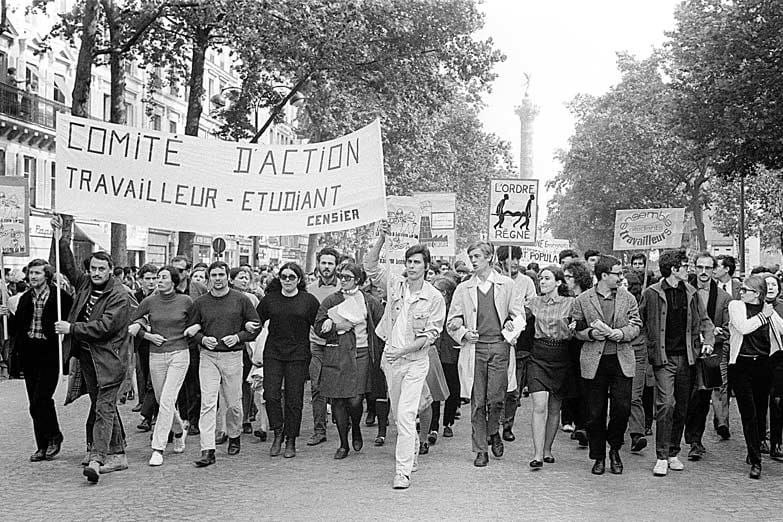
The access of a segment of the proletariat to the university would give rise to certain specific struggles within university centers in the heat of the wave of class struggle that exploded toward the end of the 60’s and throughout the decade of the 70’s. In fact, the imagery of a radical and combative student body that we associate with these years is incomprehensible if it is not placed within the framework of strong class movements that expressed themselves as an ocean of phenomena, to use Rosa Luxemburg’s expression, also in the university sphere. This must not prevent us from understanding, however, that they also featured a strong presence of leftist organizations, which would see in the student movement a breeding ground for future militants in “x” or “y” organization, all of this through the tactics we have already criticized: specific demands that could attract the largest number of potential militants, that is, activism aimed at channeling the demands of a specific political subject, the student. With this category, the utmost confusion is generated, dissolving class differences within it and creating a separate subject with its own specific interests.
This same confusion is seen in the idea of the “student strike,” which equates the categories of proletariat and of student body and establishes a false analogy between the antagonism of labor and capital with that of the student and the school. Furthermore, in the “student strike,” not only are workers’ struggles separated from that part of the working class that still remains in educational centers, but students are also separated from the workers of the educational centers—that is, the teaching staff, administrative, cleaning, and maintenance personnel, etc.—as an aspect foreign to the struggles inside of them, as places of work themselves. In this regard, our view is diametrically opposed, since we as communists understand that we must defend the interests of the proletariat in general, without making distinctions by branch, age, or job position, and not separating it according to these aspects.
All this construct revolving around the student body causes a segment of the youth, upon entering into the university environments, to seek a radical way out of this world and instead of a radical transformative perspective, to encounter false promises or hollow struggles and burn out. Furthermore, this leads them to make militancy a temporary conception, given that the militant dynamic in leftist environments comes to an end when what lies ahead is career and social success and the degree has already been obtained, when after all those radical struggles of youth what follows is settling down within the world of capital and passing the baton to the next generation, creating false militants who, in the end, are nothing more than temporary numbers lost after completing their studies.
YOUTH SUBJECT
The idea of the “student” subject, as a separate political subject, or at least with a framework for action and organization separate from the rest of the proletariat, is subsumed in an even broader idea of a “youth” subject. We find in all leftist organizations specific youth groups, what are usually called the youth wings, those breeding grounds for militants from which it will be possible to access the party proper. This is not exclusive to present-day leftism, but is a legacy of the Second and Third Internationals. As we explained before, just as the student body is brought together in a specific struggle, the aim is to bring youth together in a specific organization to fight for their immediate interests. This presupposes a whole idea of the mass party and of the tactic of frontism.
Young is the immigrant newly arrived on the Spanish shores in search of a new life; young is the student who combines their studies with a job; young is the proletarian Russian or Ukrainian sent to die at the front. Young too are the children of the upper bourgeoisie, the aspirants to the executive boards of large companies; among the young there are police officers, politicians, soldiers, etc.
Being young is nothing and tends to explain rather little, since even in the most remote place on this planet, there exist classes. To speak of youth as such is to speak in cross-class terms, just as of sexes, races, and the rest of the divisions that this world, that of capital, imposes on us. The struggle for emancipation can never be carried out by a gender, a race, or a given age bracket, for these divisions find their origin not in an abstract will on the part of men toward oppression, but in the very existence of social classes.
However, leftism tends, by half measures, to accept this discourse. It is no longer simply about feminism, but “class” feminism; it is no longer about youth, but about a “proletarian” youth. In some way, it is argued that the young proletariat is more proletarian by virtue of its youth, suffers a more precarious situation, greater difficulty in entering the labor market due to its lack of experience, which leads it to precariousness in the rest of the aspects of its life (housing, purchasing power, etc.). This would make one of the axes on which communist organizations must be based that of youth, the creation of large youth organizations.
However, one only has to think of the exploitation of the migrant proletariat, the precarization of women’s labor, or the older proletariat, which is increasingly expelled from the labor market years before retirement, facing great difficulty reentering it. Not only are there other sectors of the proletariat (immigrant, female) that live in and experience very precarious conditions, but the older proletariat also suffers, in a different yet equal way, the consequences of a crisis that increasingly expels more and more labor power, creating an ever-larger mass of surplus population, comprising both young people and adults.
CHARACTERISTICS OF YOUTH
We cannot deny, however, certain specific characteristics that youth possesses. On the one hand, it undoubtedly faces greater difficulty entering the labor market and achieving economic independence. One only has to look at the current housing problem and how it affects the ability of large sectors of the youth population to become independent. It also entails fewer family and financial obligations, fewer obligations that facilitate the development of militant activity and at the same time, as mentioned earlier, can induce less seriousness in the activity being carried out. Furthermore, youth is that moment when one begins to define the meaning of life and, therefore, that moment—though not the only one—in which a vital choice can be made, such as that of the struggle for revolution.
Its material conditions tend to make the youth more sensitive to the social situation and an element very active in the movements in which it finds itself involved. This can happen in a positive sense, when the young proletariat forms part of the most radical sectors of a class movement, or in a negative sense, when in counterrevolutionary periods we see youth serving as the spearhead of movements like Stalinism or fascism. Today we find ourselves in the erosion of an ongoing counterrevolutionary period, in which the proletariat has not yet rid itself of the burdens that have denied its emancipatory perspective for a century, even though it is pushed toward growing social conflict by the historic crisis of the system. Within this framework, we can understand the regimentation of a portion of youth today, both in the extreme right of capital, with organizations in Spain such as Núcleo Nacional or Falange, and in the left and far left wing of capital, fueled by the force of submission of antifascism to democracy. It also allows us to understand, well beyond the snapshot of the moment, the processes of radicalization of the young proletariat in search of a programmatic perspective capable of confronting in earnest this moribund mode of production.
TURNING YOUTH INTO A SUBJECT?
These characteristics specific to the proletarian youth are what makes it so that more and more youths draw closer to positions class and revolutionary.
However, this cannot lead to making the proletarian youth a specific or identitarian subject. This would be to fall back into the divisions imposed by capital and enter into its own logic. Communists do not organize around their gender, nationality, or age, but as communists, that is, around their program. The Communist Party is a prefiguration of the future society, the communist society. Its functioning is fervently anti-bourgeois, anti-democratic, anti-individualist. We cannot allow the divisions inherent to capital, which we nevertheless cannot avoid, 1 to penetrate our party in a harmful way. It is fundamental “that in the party one can strive to give life to an environment fiercely anti-bourgeois, which broadly anticipates the characteristics of communist society, is an old formulation and example for young communists.”2
Evident is the militant impoverishment, in every sense, of organizing separately from the comrades who are older, both for the youth and for the comrades who no longer are so. It would be naive to deny the obvious differences between the two, and it is precisely for this reason that the need for a joint organization takes on even more value, where experience can teach and set an example to all that is new, and the new can break with all that which remains anchored to the past, under the same program, under the same principles, under the same organizational form, under the same banner, that of invariant Marxism.
The spearhead of the revolutionary camp has always been full of young proletarians. In the Italian Socialist Party, the youth took a stand and provoked countless debates within the Party, disorienting the “old ones” who had always underestimated the FIGS (Socialist Youth of the PSI). This is precisely the reason for not making of the youth a subject, for breaking those separations that capital makes, for creating a fiercely anti-bourgeois environment. Because the revolution is not a question of races, of genders, or of ages; it is a question of class, of one class, the proletarian one.
“The entire bourgeois environment leads to individualism. Our socialist and anti-bourgeois struggle, our revolutionary preparation, must be aimed at laying the foundations of the new environment. This is what we consider an integral program for the youth movement: to liberate the development of character from the exclusive influence of present-day society; to live together, whether we are young workers or not, breathing a different and better atmosphere; to cut the bridges that unite us with non-socialist environments; to cut the ties that permeate our blood with the poison of selfishness and competition; to sabotage this infamous society, creating revolutionary oases destined one day to invade it completely; to dig mines destined to shake it to its foundations.”3
CONCLUSIONS
We, the communists, are young, old, students, workers with or without papers, unemployed, retirees… but our participation in the immediate struggles of the proletariat is not determined by any of those characteristics. Above all, we participate in class struggles as communists.
And it is in that sense that the critique we develop of the student or youth movement is necessary, precisely because communists do not engage in student unionism nor build youth collectives. As explained previously, the task of communists is not to build struggles. Without a spontaneous impulse of a movement that tends to spread, generalize, and self-organize, the “movements” built by activists can only be partial movements, whose ultimate aim is to achieve reforms and build apparatuses of mediation with the State to achieve them, and where any reference to the struggle directed against capitalism is purely ornamental.
In that sense, the student movement is alien to us. This critique is not aimed at proposing what the student movement should be, but at rejecting it outright. Because it stems from a cross-class category, the student body, it dissolves young proletarians in training into it, separating them from the rest of their class, and leads them to the defense of the state education system as a form of “working-class conquest,” when it is only a different form of management of their misery in this system. In contrast to the student movement, as a movement that is organized in itself from and for reform, we intervene as communists, without separations of gender, race, or age, there where struggles break out that have a dynamic of their own, where there is a real movement of the class capable of breaking, even if only potentially, the separation between the immediate interests of the proletariat and its historical interests.
1 As determinate beings, we cannot claim to escape, by means of a supposed absolute freedom, from the determinations and forms of consciousness that this mode of production imposes. It is illusory to think that, within the Party, sexist, racist, or individualist behaviors will disappear. Precisely for this reason, both the conscious struggle against them and the development of organizational forms and working methods that, as far as possible, prevent them become essential
2 A program: l’ambiente, L’Avanguardia, 1913.
3 Ibid.