

Letter on the Communist Left

Donwload here
Recently, a comrade wrote to us by email to ask what differentiated us from other groups stemming from the Italian communist left, such as the TCI or Il Partito. We are publishing our response in the belief that it may also be useful to other comrades reading us. Following it, he asked us about our characterization of Trotskyism and especially of the French Trotskyist organizations.
Dear comrade:
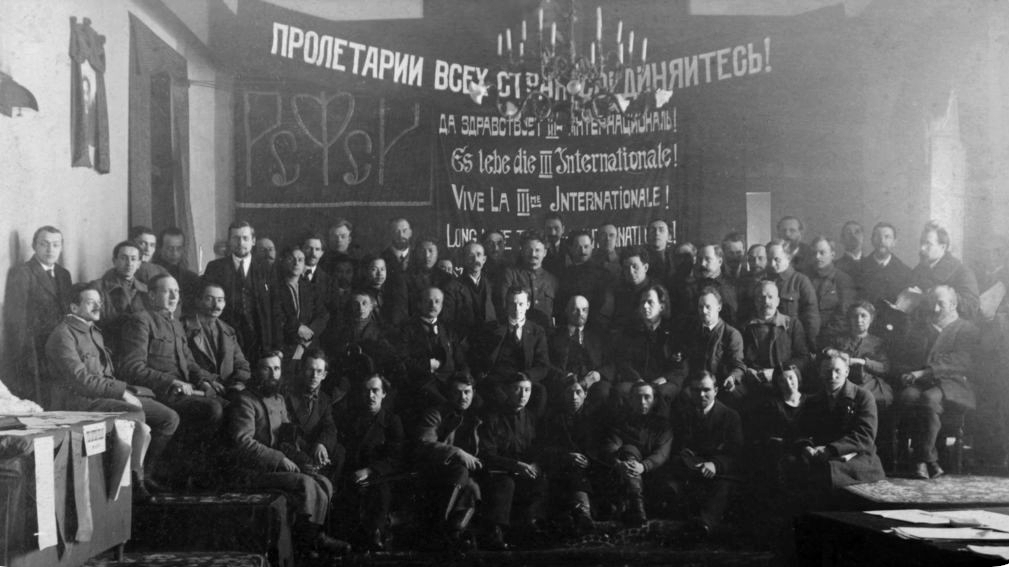
To answer your question, we would have to start by explaining that, in reality, if we retain the term “communist left,” it is because the history of our class has not yet been able to fully break with the counterrevolution, which has appropriated the term “communist” pure and simple. As an example of what we mean, one need only consider that the revolutionary wave that began in 1917 needed to break with the term “social democracy” and found in the trunk of our collective heritage that of “communism” and “communist,” which after Marx and Engels had fallen relatively into disuse. The “communist left” is a poor term because it is anchored to the conditions of its emergence: first, the struggle against the opportunism of the majority positions in the Communist International, and later against the degeneration of the revolution worldwide. Although Trotsky and the Left Opposition also fought against this degeneration (they were the main organized current worldwide against Stalinism), and within it we find many valuable comrades, both well-known and anonymous, from their defense of the Allied camp in World War II onward, we consider that Trotskyism crossed the class line never to return. All the valuable comrades in that current, such as Munis and the Bolshevik-Leninist group in Spain, Stinas in Greece, Ngo Van in Vietnam, or the comrades of the RKÖ with Georg Scheuer, would have to break with the Fourth International to remain communists. In short, the next revolutionary uprising of our class will settle scores with the language that the counterrevolution itself stole and distorted from us.
That said, we consider that within the communist left there are different currents, but all of them on class positions despite their differences, and among them we also include the German-Dutch left. If you are interested, we try to explain the elements in common between the German-Dutch left and the Italian left in this short pamphlet translated into English.
From this prism, in which we understand the communist left as the most advanced effort of our class to draw programmatic lessons from the revolutionary wave of 1917, we recognize ourselves in the Italian left as the comrades who go furthest in that effort. Their critique of democracy as an expression of capitalist relations, their explanation of fascism based on the needs of capitalist development and their critique of antifascism as a mechanism for subordinating the proletariat to the bourgeoisie, their prioritization of programmatic principles over tactical flexibility, and of the world party (the International) over national parties—including the Russian one—as well as their relentless denunciation of the ongoing counterrevolution, are qualitative. Bordiga is decisive in the development of these positions, but they belong to the Italian left as a whole. At the same time, Bordiga would maintain a series of positions stemming from the Third International, such as the defense of national liberation movements (with his idea of double revolution), trade unionism, or, on another note, the justification of the crushing of Kronstadt, which other comrades would eventually call into question, such as Vercesi in Bilan or already in the PCInt and Damen later on with Battaglia, some time after the 1952 split. These aspects, which were present in the Bordiga of the PCInt—but within a general critique of all forms of party activism and voluntarism that controlled their worst consequences—would become much more pronounced in the PCInt after his death with the arrival of the wave of struggles of the 60s and 70s. What distinguishes us from the various PCInts are precisely these traits. On the one hand, their trade-union activism, more or less pronounced depending on the PCInt in question (see Munis’s critique of the unions in Unions Against Revolution). On the other hand, the defense of the double revolution (see here our critique) which, although most of the PCInts consider it outdated, was behind the 1982 explosion, with the defense of the Palestinian PLO by Programma’s Algerian section. Finally, we consider that the current PCInts have a self-proclaimed vision of the communist party, far from Bordiga’s perspective on the distinction between the historical party and the formal party—the same Bordiga who worked with Camatte on the party text Origin and Function of the Party Form, long before this comrade lost his way and denied the proletariat as the sole revolutionary subject. For us, the party can only be constituted in the vicinity of the opening of the revolutionary crisis, in the heat of the class struggle, because the class party can only be a factor of history after having been its product, when (at the same time) the class itself constitutes and affirms itself as such. In the meantime, the organization of communists is essential, and as a communist organization we take on party tasks, but we do not have the presumption that our small group is either the true party of the proletariat or the germ of that future party to which the rest of the revolutionary minorities should look.
We agree with the TCI on the critique of trade unionism and the national question. However, we believe that Bordiga was right in his critique of Damen regarding the concept of “state capitalism,” as well as in his affirmation of the invariance of the program (which does not deny its evolution), of the catastrophic, non-decadentist, and non-consciousness-based view of the revolution implied by his notion of the reversal of praxis, as well as the notion of organic centralism against a more democratic view of the organization (here the comrades from n+1 explain organic centralism very well, in our view). We believe that, contrary to the monolithic idea that the PCInts have of the Italian left tradition (which their radical defense of anonymity helps them maintain), comrades like Bilan or later the new generations of Programma (before the explosion of ’82), such as Jacques Camatte himself, Roger Dangeville, Lucien Laugier, or Carsten Juhl—with all the differences existing among them and their subsequent trajectories—nonetheless worked to develop the programmatic framework established by Bordiga together with the comrades of Programma, going beyond the limitations they inherited from the Third International. In this line we recognize and assert ourselves within this tradition. For this reason, we believe we can say that we work in the programmatic thread bequeathed by Bordiga, without needing to identify with the current positions of the PCInts in their strategic and tactical aspects.
I hope this letter, already quite long, has helped clarify the matter a bit. Apologies for the length, but your question deserved it. If you have any comments or reflections to make based on it, we would appreciate it if you sent them to us. We would also like to know a bit more about you if you feel like telling us.
Fraternal greetings