

Letters on the Dictatorship of the Proletariat and the Transition to Communism

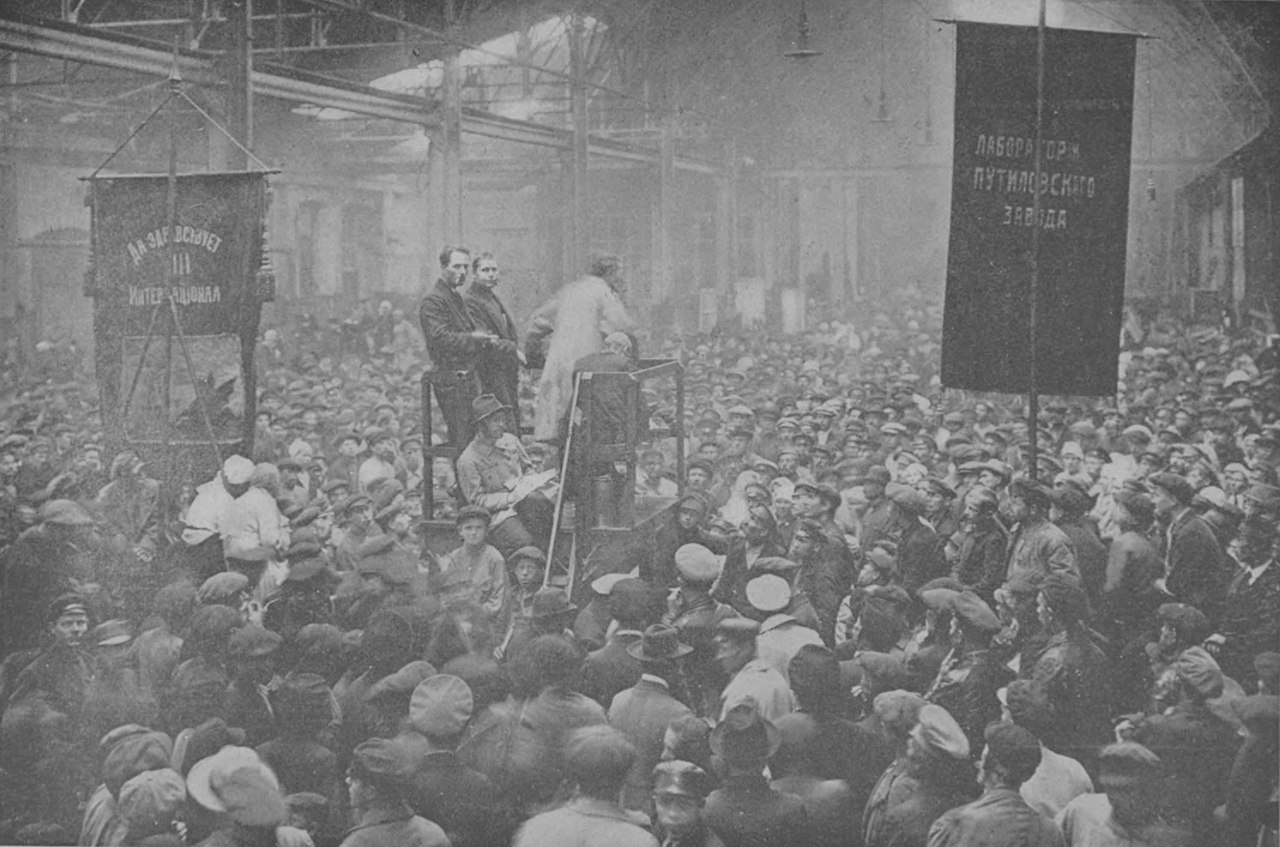
We are publishing the following email exchange with an international comrade who asked us about our differences with communization and our position on some of the problems posed by the dictatorship of the proletariat and the measures for transition to communism. We believe it may be helpful to other comrades who read us.
International comrade
I have long been wondering, what would prevent an international proletarian revolution (the kind that your organisation advocates for, which maintains a strong central authority under the party to coordinate planning and doesn’t immediately begin the transition torwards communism, different from what “Communisation theorists” would advocate) from “stagnating” and remaining in a state of DOTP [Dictature of the Proletariat] forever, never really moving towards communism? Is the success of an international revolution enough to prevent a bureaucratic takeover?
And even if this takeover is prevented, wouldn’t there still be some central authority which would be formally incentivized to maintain a state where they are in power? I understand that there has to be a party in order to canalize the impulses of the class, but this party being given formal state power, in my view, could bring some issues… Which is partly why I’ve considered myself closer to communisation theory than to various “Italian left communist” currents. My logic is that “better move to communism as fast as possible before the revolution calcifies”, in a way.
Does your organization have possible answers to my question? Rebuttals to my conclusions I’ve reached? I would really appreciate an answer, thank you very much!
Barbaria
Hello, comrade,
The question you’re asking is a complex one and would require a longer conversation than what an email can allow. For us, the dictatorship of the proletariat is not a choice, but a historical necessity—one shaped by the past experiences of our class.
We consider ourselves part of those comrades who, from different communist currents, fought in the past against the theory of socialism in one country and upheld the idea that value can only be abolished through a world revolution. But if that’s the case—since such a revolution cannot occur simultaneously across all territories (even if capitalism’s development increasingly synchronizes global conditions)—classes will continue to exist, and the proletariat must assert itself against the bourgeoisie to impose its own needs against value.
This means it must destroy the bourgeois state and establish its own political power—something that, by definition, entails centralization under the leadership of revolutionaries, whether they are organized in a world party (which we believe is necessary) or in other forms. We don’t believe there’s any other materially possible solution, even if we would love to abolish that dreadful machine—the state—through our own will at the very moment of insurrection.
In any case, a whole series of transitional measures will be essential, as defended in Bordiga’s “Immediate Revolutionary Program” at the Forlì meeting in 1952, and as has been further developed by the comrades of n+1. But it’s crucial to distinguish these transitional measures—which always involve a struggle against the tendency of value to reassert itself in our social relations—from genuine communizing measures, where value is progressively abolished, city by city, town by town.
We believe one of the key lessons of the counterrevolution is this: capitalism has not been defeated until the world revolution is victorious, even in the insurrectionary territory. Forgetting that can lead to the gravest consequences and leave us disarmed in the face of the immense challenge posed by the dictatorship of the proletariat.
Precisely because of this pressure for value to reimpose itself—both from outside and within the class dictatorship—and as you rightly point out, the time we have for this process to succeed is not unlimited. There is a deadline, after which the process will begin to decline. We don’t know what signs of exhaustion in the dictatorship of the proletariat will look like under present-day capitalism. There will be some similarities, and many differences, compared to Russia in 1918–1921. But we do know the most important thing: once that exhaustion sets in and no new proletarian insurrection occurs elsewhere to revive the forces of our class, the dictatorship of the proletariat will cease to exist. What will remain is a capitalist state, which we must abandon if we want to preserve the possibility of a new revolution in the future.
It would have been better to let Kronstadt fall—and, if necessary, all of Russia—than to allow the degeneration that first contaminated the dictatorship of the proletariat, then the Bolshevik party, and finally the International itself. Had we organized a retreat in Russia, we could have preserved revolutionary theory and its essential tool—our international organization—in order to clearly confront the coming assaults in the UK (1926), China (1927), or Spain (1936).
For us, the lessons drawn by Bilan during the 1930s were crucial: the critique of the Bolshevik mystification of violence, the importance of decisions within the dictatorship of the proletariat being made from the International to avoid the conservative tendencies of the state, and above all, the centrality of the task of extending the world revolution.
In this text translated into English, you’ll find a more developed synthesis of those lessons.
We don’t want to make this response any longer than it already is. Feel free to ask more questions, let us know if you’d like us to elaborate on any point, or share your own perspective.
Communist greetings
International comrade
Thank you very much for the answers, they were quite enlightening!
Still have some questions though. No need for long answers if you do not wish to (but I nonetheless appreciate them)!
First of all, if I’m understanding well, one of your (well, Bilan’s) proposal to counter the conservative tendencies of the state is that political decisions be made from the international separate from the state (so that the party wouldn’t take the role of ‘managers’) right? I’m sympathetic to the idea, but I have a hard time imagining how this would work concretely.
Secondly, would the international be separate from the party/its central organ? Wouldn’t it be more influenced by where it is situated, and so couldn’t it lead to a sort of “bolshevisation” situation, where interests would shift from internationalism to support for a state?
Thirdly, I don’t really understand how opportunism and bureaucratisation could be prevented within the central organ of the party and within the international, whether they be organized through democratic centralism, organic centralism, or whatever Damen proposed (“dialectical centralism”). The ‘first generation’ would likely be truly dedicated, but it’s possible that the successors might twist its goals. Following an invariant program could solve plenty of issues with this, but I feel like this could go counter to a materialist analysis of how power works, could it not? After all, it is material conditions and the relationships that form from them which determine how people act, not the ideological superstructure, no?
And finally, how do you suppose that the central organ of the party or the DotP would assert its “will” when the impulse of the rest of the proletariat is not enough (say, for example, abolishing the distinction between town and country by banning constructing housing in cities)? Would it use the police? Would it instead utilize especially dedicated insurgents without formal authority but who, representing the party directly, are respected by many? If it is using a force outside of the insurgents themselves, isn’t there a chance that this hierarchy ‘replicates’ itself and that it could seek to forever justify its own existence, twisting its own role? (For instance, a production council system using delegates could, over time, transform into a command economy, where delegates only serve to ensure communication between the state and workers who would follow due to ‘necessity’ (despite there being no money in play)).
I apologize for the lengthy questions, I’m simply quite curious!
Barbaria
Hello, comrade,
These are good questions, and all of them are profound. We believe there are two central aspects to the method for drawing lessons from the counterrevolution and for guiding ourselves in facing the challenges of the dictatorship of the proletariat.
First, revolution is not a matter of organizational forms. Therefore, no organizational form can safeguard us from the process of revolutionary degeneration. If workers’ democracy had been preserved in Russia—with the soviets acting as a legislative power and the soviet government elected by them acting as an executive power—that would not have prevented the strengthening of a capitalist state apparatus and the creation of a network of interests aimed at maintaining the exploitation of the proletariat and subordinating the interests of the global proletariat to those of the Russian state. As Western democracies have shown, this process could well have coexisted with a democratic political system—but if at any point it had become an obstacle, the new Soviet bourgeoisie would have simply found a way to get rid of it. No constitution, no specific political or legal form would have prevented what initially appeared as opportunism and bureaucratization and gradually revealed its true class nature.
The only thing that can prevent the dictatorship of the proletariat from ceasing to be such—and turning into the dictatorship of capital, whether more or less democratic—is the extension of the world revolution. If that does not happen, degeneration will occur sooner or later.
However, this does not mean that all is lost. For us, the tragedy was not that the Russian revolution degenerated, but that it did so while dragging down the International and the revolutionary program with it. Revolutions can be lost, leaders can betray, but neither of those things had to lead to a counterrevolutionary period in which class struggle for the next hundred years would be unable to connect with its historical interests and acquire a revolutionary direction. What opened the counterrevolutionary period was the complete distortion of the communist program—where socialism could exist in a single country, internationalism turned into the defence of the Russian state, the International became its transmission belt, the value law could be “socialist,” and socialism in practice meant working to exhaustion under Stakhanovism and killing German proletarians in defence of the “socialist homeland.”
This inversion of all terms caused massive disorientation: new generations of proletarians grew up thinking this was socialism—some would go on to defend it, thereby defending one of capitalism’s worst expressions; others would react by falling into the other side of the counterrevolution—defence of Western democracies; and many others would simply become disheartened and retreat into private life. In this context, revolutionary minorities could no longer constitute new class parties, because there was no class in the historical and political sense. These minorities were thus forced to take up the task of drawing lessons and restoring the revolutionary program.
The second methodological point to keep in mind is the critique of the mystique of violence and of voluntarism. Communism cannot be decreed. It is a radical change in social relations that, by definition, can only be carried out by the agents of those relations. If the proletariat is not prepared to carry it out, no party willpower can substitute for that. On the contrary, if the party uses violence against its own class to impose its will, it will simply sever its link with the class, cease to be a class party, become a bourgeois organization at the helm of the bourgeois state, and devote its activity to reproducing itself as a ruling class through the state apparatus—as you point out in your last question. If, during the revolutionary process, the proletariat stops fighting for its historical interests, no grand strategy or iron will can take its place. In that case, the best thing we can do as revolutionary minorities is organize a retreat and return to our tasks of clarifying and expanding the program. Only that will allow us, in the next revolutionary wave, to reunite with the proletariat in struggle and finish what we started.
In this regard, it’s very timely that you bring up the question of materialism in our conversation. Historical materialism does not deny the role of consciousness and will—it simply places them in their proper context. If it denied them outright, there would be nothing to prevent capitalism from continuing until our extinction, since capitalist social relations are highly contradictory but also automatic, and they subordinate everything to the valorization of capital. Therefore, if there were no possibility that awareness of this fact could become a social force capable of ending it—through the class and its party—we would be wasting our time with this conversation.
Being determines consciousness, and capitalism produces its own historical gravedigger: the proletariat, along with its revolutionary theory—its program, the compass of its action—embodied in revolutionary minorities and, at key moments, in its party. What we are saying is that the only way we as a class can face the challenges of the revolutionary process is precisely through our collective and historical consciousness—our program. That is why Stalinism was so destructive, and why the lessons of the counterrevolution are so essential for us in restoring the possibility of a new revolution.
The program will not prevent the conservative force of the state or the persistence of value in our social relations from continuing to foster opportunism and bureaucratization. But it will allow us to confront these tendencies much more clearly than in the past and not mistake them for the foundations of an emancipated society. And above all, it will allow the rest of the world communist party to remain an organ for the effective leadership of the revolution in other territories, avoiding the process of “Bolshevization”—that is, the spread of degeneration—that you mentioned.
Your initial questions are more specific, and for that very reason, it’s easier for the actual experience to differ from what we had imagined. We will try to answer them though. We do not believe that the party should stand aside from the proletarian state, leaving its leadership to de-ideologized officials—or rather, to those imbued with the common sense of the dominant ideology. As communists, we must effectively lead the dictatorship of the proletariat, with all the risks that entails, because we do not believe that any alternative would be either beneficial or realistic under the circumstances.
What is essential is that the major debates on how to carry out that leadership must take place within the International, alongside the rest of our party, and not in the insurrectionary territory. The Bolshevik Party was deeply engaged in such debates starting in 1918, as shown by the left-Bolshevik journal Kommunist, until Stalin eventually asserted his dominance. These were rich and profound debates—crucial for the course of events—but they occurred behind the back of the International, neither within its leadership nor at its congresses. That is a mistake we must not repeat.
Naturally, many day-to-day matters will have to be decided and implemented on the ground. But the major lines of the process must always be discussed. What the Italian Left has insisted on since the 1920s is that this discussion must be international.
We hope we’ve managed to better explain the key points of the debate.
International comrade
Thank you very much for the answers! Here’s a few questions:
- I am aware that communism is impossible within one country, and I tend to agree! But why would the issues of the bureaucratism and opportunism, in your view, not appear/would be ‘solved’ by the realization of a global revolution. Would there not still be bureaucratic mechanisms in place? Would there still not be a tendency for people to want to maintain their (possibly informal) ‘jobs’ through opportunism?
- The Revolution cannot be realized by decree. But why would whatever coercion against the proletariat (for instance, if a lot of proletarians continue trading with money, or keep using a factory for profit, maybe they’d require coercion, either by ideologically committed proletarians, or possibly through an apparatus), which I suppose you somewhat support, not bring a risk of recreating a state apparatus which would lose the support of the proletariat?
- As for the proletariat being prepared to “carry it out”, would a communist revolution require the support of the majority of proletarians? Because, to minimize a state apparatus ‘having to’ enact it’s measures by decree or force against proles, proletarians would need to broadly be aware of and in favor of communist measures, would they not? But why would they support these measures if it would lead to their end of their existence as a class? I guess I’ve often struggled to understand why communist revolution is in the class interest of the proletariat broadly.
- Not sure if I’ve asked this before, but If the party (which, as I’m understanding it, isn’t some central formal circle of bureaucratic positions, but rather an “organic” group of people which would follow a program) will discuss, debate, and eventually reach conclusions: how will it get those conclusions enacted? Two issues appear: the international, if outside of revolutionary territory, might get hunted by those that seek its destruction. The other problem is that they, the central organ of the party, could have a hard time communicating it’s will to people in revolutionary territories. and little guarantees that the revolution would agree to follow whatever suggestions they bring (as was the case in the USSR. Much coercion had to be used, even against proletarians. But coercion also creates a risk for a party which “rules over” a proletariat and for bureaucratism).
Whatever the answers may be, I thank you a lot for answering my questions.
Barbaria
Dear comrade,
The debate over the nature of bureaucracy in class societies in general, and in capitalism in particular, is of great importance. It became especially relevant after the Stalinist counterrevolution. As our comrades from Matériaux Critiques explain in «À propos du concept de bureaucratie» (which we strongly recommend if you read French), and as we also develop in El capitalismo de Stalin, the lack of theoretical tools to confront what was happening in the USSR led many to describe bureaucracy as a new ruling class, and the process of bureaucratization as a phenomenon in itself tied to the dictatorship of the proletariat—hence the need, they argued, to look for alternative solutions. In our view, however, and as Bordiga insisted in his Supplements to “Dialogue with the Dead”, bureaucracy was not the product of the dictatorship of the proletariat, but of its degeneration.
First of all, it is necessary to understand that commodity society multiplies the administrative needs on which bureaucracy rests. This is because the separation between production units, and the competition among them in the form of enterprises (whether public or private), demands vast amounts of legal rules and procedures: to ensure that no one gains an “illegitimate” advantage over others in competition; that contracts are honored; that civil and commercial rights are equally guaranteed to all capitalists in conflict; that the State maintains its neutrality in this struggle; that competition among individual capitalist interests does not become counterproductive for the general interests of capital (for instance, by undermining the reproduction of labor power or of the natural resources that constitute constant capital), and so on. The anarchy of capitalist production does not require less regulation, as old and new liberals would like to believe, but far more than a planned economy ever would. That is why we argue that the centralization of production for social needs—the basis for the abolition of value and the extinction of law that follows from it—does not increase administrative regulation but reduces it. This is also why integral communism establishes an organic, self-regulating, and self-conscious society. Our comrades at n+1 have worked extensively in this direction, and many of their writings are valuable for exploring it further.
On the other hand, wherever an overabundance of regulation coexists with the existence of social classes, bureaucracy arises—not as a social class in itself, but as the servant of the ruling class, preserving its interests through the State. And wherever bureaucracy exists, as the comrades of Matériaux Critiques emphasize, corruption exists as well, since the different factions of the ruling class attempt to influence it in order to use the collective resources it manages for their own benefit. The reflux of the world revolution, together with the material difficulties of the Russian civil war, encouraged the proliferation of bureaucracy within the Russian State. Yet it only began to consolidate with the degeneration of the revolutionary process: the hollowing out of the soviets, the progressive identification of the Bolshevik party with the State, and ultimately the rearrangement of Russia’s capital accumulation dynamics. It was the consolidation of capitalist relations that truly strengthened the Soviet bureaucracy.
On the contrary, the advance of the world revolution and of the dictatorship of our class will necessarily be accompanied by the development of transitional measures that gradually strangle the domination of value over social life. For us—unlike the perspective of communization, which denies the need for the dictatorship of the proletariat—it is crucial to affirm its necessity against value. This presupposes an arena of action that is still capitalist, until the victory of the world revolution allows for its definitive abolition. But it also implies concrete transitional measures that reshape the material basis on which the revolutionary process unfolds: making basic subsistence goods free of charge, reducing the working day to its minimum expression, systematically increasing social spending in Department II of production (means of subsistence) over Department I (means of production), abolishing schools and university degrees that merely reproduce the social division of labor, and so on. Strengthening this process will eliminate the material foundation on which bureaucracy could arise, since it will have no particular privilege to safeguard against the rest of society.
This connects to your second and third questions. From the moment it first appears in history as a class, the proletariat has fought against its exploitation and, therefore, against its very condition as an exploited class. The struggle to satisfy its needs drives it to fight against the categories of capital that deny them, crush them, and subordinate them to the interest of valorization. Wherever there is exploitation, there will be resistance and struggle. What distinguishes the proletariat, as an exploited class throughout history, is that this very movement leads it to affirm the radical transformation of social relations: abolishing the categories that uphold the very existence of classes, private property, the family, and the State.
Revolution is a global process, one that radically transforms both consciousness and the material basis on which it is shaped. In it, affirmation and negation go hand in hand. During the dictatorship of the proletariat, the political protagonism of the class through its territorial organs (what the soviets or councils were in the past) is essential—but not sufficient. It is also necessary that the material conditions of life themselves be transformed, which is why the transitional measures we mentioned are so important. For if the dictatorship of the proletariat were to retain the same material conditions as the dictatorship of capital, there would be no reason to sustain it. Only through the political affirmation of the proletarian class—by means of its dictatorship against counterrevolution—and through the process of its self-negation as a class—by means of transitional measures that attack the social division of labor and the domination of the commodity—can the revolutionary process endure over time. For while the insurrection is not carried out by the entirety of the proletariat but by a very large minority, expressed through its class organs and finding political direction in the party, the subsequent dictatorship can only be maintained with the active support of the majority of the proletariat.
That said, for us it is essential to understand that none of these internal measures can be sustained for long if the revolutionary process does not extend beyond the borders of the insurrectionary territory. As we have already discussed, if the advance of the world revolution stalls and the revolutionary process at home begins to show signs of exhaustion, social phenomena will emerge that counteract or run against the consolidation of the transitional measures. Our task as revolutionaries must be to distinguish these social phenomena from antisocial behaviors of an individual kind. The latter will appear at the beginning and throughout the revolutionary process, whether it maintains its vitality or declines, and they will only begin to disappear as the world revolution triumphs and communism can begin to reproduce itself on its own foundations. These antisocial behaviors must be confronted by means of social pressure and, when necessary, coercion—though the organizational form that takes on this task is a complex discussion.
A very different matter arises with social, mass phenomena that oppose transitional measures and express the exhaustion of the revolutionary process within the insurrectionary territory. We may think, for instance, of the proliferation of the black market during the so-called “war communism” in Russia, or of the demands of the Kronstadt uprising, which called for the restoration of market relations between town and countryside. When such things occur, we must be very careful to understand the causes behind them, and not attempt to impose by state force what is not being collectively embraced by our class—as Bilan emphasized in its lessons from Russia—and, if necessary, take a step back, as the Bolsheviks eventually did with the NEP.
The theoretical foundation behind all these points lies in our conception of the relationship between class and party, which brings us to your fourth question. We believe the party must lead the dictatorship of the proletariat, which means it must exercise effective control over the direction of the proletarian semi-State. Unlike other conceptions, we do not believe the party should restrict itself to a purely “consciousness-raising” role, limiting itself to offering considerations from the soviets while other elements lacking clarity about the proletariat’s historical interests actually direct the State apparatuses. But our understanding of the party’s leadership over the class is not a bourgeois one—not that of a general staff issuing orders to a disciplined mass of soldiers who carry them out without needing to understand them. Revolution is characterized precisely by the opposite: by the conscious self-activity of the class in the development of communist social relations.
For us, revolutionary leadership is leadership in the sense of a vanguard—that is, of those who are part of the same movement but form its spearhead by virtue of their determination and clarity, and who therefore enjoy the respect and trust of the rest of the class in struggle. If this movement begins to decline—if the rest of the class becomes discouraged, loses confidence, and expresses this through resistance movements against the proletarian semi-State—then this means the link between party and class has been broken, and it is necessary to abandon the State. The leadership of the party over the class is not intellectual but effective. Yet it is programmatic and political, and for that reason it cannot be restored by throwing opponents into prison. On this point, Bilan’s work is fundamental for us.
From this perspective, the question of the world party (the International) becomes clearer. As you rightly say, there are technical and security considerations that mean its congresses and its leadership will convene in the insurrectionary territory. What is essential, however, is that the leadership be international in its composition—bringing together revolutionary leaders from its different national sections—and that the congresses openly and decisively debate the guiding lines of action within the insurrectionary territory. Naturally, day-to-day matters will involve issues that could not have been discussed in these assemblies, but when the programmatic and strategic outlook of the organization as a whole is the same, translating it into the concrete activity of its militants and sections ceases to be such a major problem.
This would lead us to the question of organic centralism, though perhaps this letter has already grown too long to enter into it here. We do, however, recommend the reading—if you read French—of Mitchell’s text “Critique de la genèse des partis de la IIIe Internationale (Matériaux pour l’élaboration d’une plate-forme de la Fraction)” in Communisme no. 16–17, which you will find in the link we leave below along with the other recommended readings.
A warm greeting, and we look forward to continuing the discussion.
Matériaux Critiques: «À propos du concept de bureaucratie» y «Quelques éléments sur la période de transition»
Barbaria: El capitalismo de Stalin
Bordiga: Complément au “Dialogue avec les Morts”
Vercesi: La question de l’État y La dictature du prolétariat et la question de la violence